Two Rooms, One Open Door
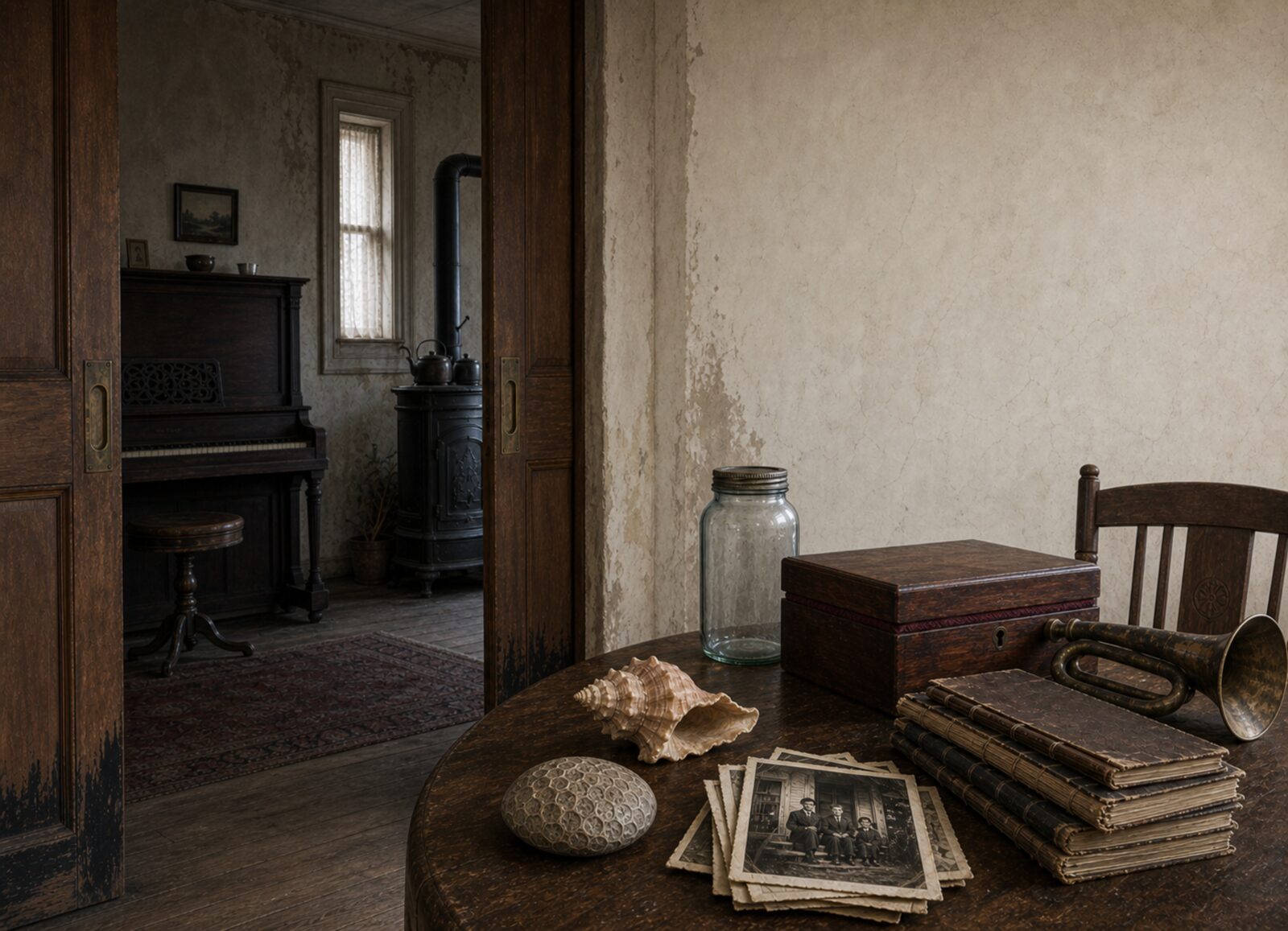
The cover of this book is two rooms and a doorway between them, standing open. On this side: a table holding a jar, a box with a lock built into it, a stack of bound journals, photographs, a shell, a stone. Through the doorway, in the room beyond: a piano gone quiet, a stove gone cold, a window still letting the light through the lace.
The Recluse is available now in print and ebook.
I should probably be better at saying that plainly: here is the book. It exists. You can read it now.
But I also want to talk about how it works. The Recluse is the second volume of The Rose Covenant, an eight-volume series written in reverse chronology, each book moving earlier in time. That sounds neat in a sentence. It is not neat when you have to write it.
When a series moves forward, the writer builds consequence in the usual direction. Reverse chronology asks for the opposite: you start with aftermath, an object already carrying more history than the reader can know, and move backward to earn the weight it already had.
That was the craft problem of The Recluse - a book about an investigation, but not the mystery kind. The question isn't what happened. It's what kind of life left this much evidence behind.
The past doesn't arrive because the narrator announces a flashback. It arrives through matter - a sound, a smell, a piece of paper held in the hand. I needed it to feel like it belonged to the house, not pasted into an investigation.
Discovery first, explanation after - that was one of the book's rules. The floor is a floor before it is evidence; explain too quickly, and the house becomes a lecture instead. I hate novels that walk you over to a symbol and wait for you to admire the machinery.
That mattered because The Recluse works in two registers: forensic on the surface - records, measurements, repairs, labor - and sacramental underneath, the idea that matter can carry moral weight without ceasing to be matter. A vessel is a vessel - but enough faithfulness and repair passing through a thing gives it more than its physical use.
The challenge was keeping both alive without either bullying the other. Too forensic, and the book becomes an inventory. Too sacramental, and it becomes fog.
This is where reverse chronology became both the difficulty and the pleasure. The reader of The Recluse has already passed through The Excursion - they know where this world ends up. So when The Recluse moves backward, they aren't arriving empty-handed. That gives every scene a second shadow.
I wanted the earlier book to deepen The Excursion, not just explain it. The promise of writing backward is that you don't answer every question - you change the weight of the ones the reader already had.
There were days when a small detail locked into place and carried time in both directions - one thing in The Excursion, another in The Recluse. Those moments are why the architecture is worth the trouble, and also why it's dangerous: a series like this can turn too clever, every object a clue, every room a future revelation. I have limited patience for puzzle boxes unless someone's actually storing something useful in them.
The cure is the same every time: go back to the material. What would a man repair carefully because he could not bear to let it fail?
That question made the writing personal. My wife and I have lived for years in the house that informs The Recluse - repaired it, argued with it, misunderstood it - and come to recognize that restoration is never only about making something look better. It's about learning what kind of custody you've accepted.
Not ownership. Ownership is legal; custody is moral. Ownership tells you what the deed says. Custody asks what the thing entrusted to you requires. The Recluse is, among other things, a book about custody - of a house, of grief, of what a previous generation could not say clearly but still managed to leave behind.
That is why the book needed the reader to encounter residue first - the worn place, the old document, the silence - before asking what kind of life made them. Read it slowly. Not because slow reading is more virtuous (sometimes slow books are just boring books with better posture), but because the book is built as an investigation. Let the evidence accumulate.
If The Excursion was the threshold into The Rose Covenant, The Recluse is the first descent into the house beneath it - colder, more forensic, more architectural. It asks a different question: not only whether hope can survive, but what had to be kept, damaged, hidden, and handed forward for hope to have somewhere to stand.
Custody doesn't end the day you take it on. It's what you choose again the next morning - with a house, with a record, with a book that isn't finished just because it's printed. That was the discipline of writing this one, and the actual house still asks it of us.
The book itself is done now - bound, printed, and out in the world. The Recluse is available in print and ebook.
The doors in that photograph are still open. That's not just where this book starts. It's where the next six start too.
- Peter James Stouffer
Rose Township, Michigan
2026