Elias Thorne is dangerous because his despair is articulate. He does not merely suffer; he builds an interpretation of suffering, then tests the world against it as if subtraction could become a form of truth.
The book does not answer Elias by making him foolish. It lets his intelligence remain intact while showing the cost of his experiment. These passages trace the movement from bottomlessness and contempt toward the small, humiliating breach where the damp and the light get in.
Elias Thorne · The Excursion II.iv
How Much Can a Man Subtract
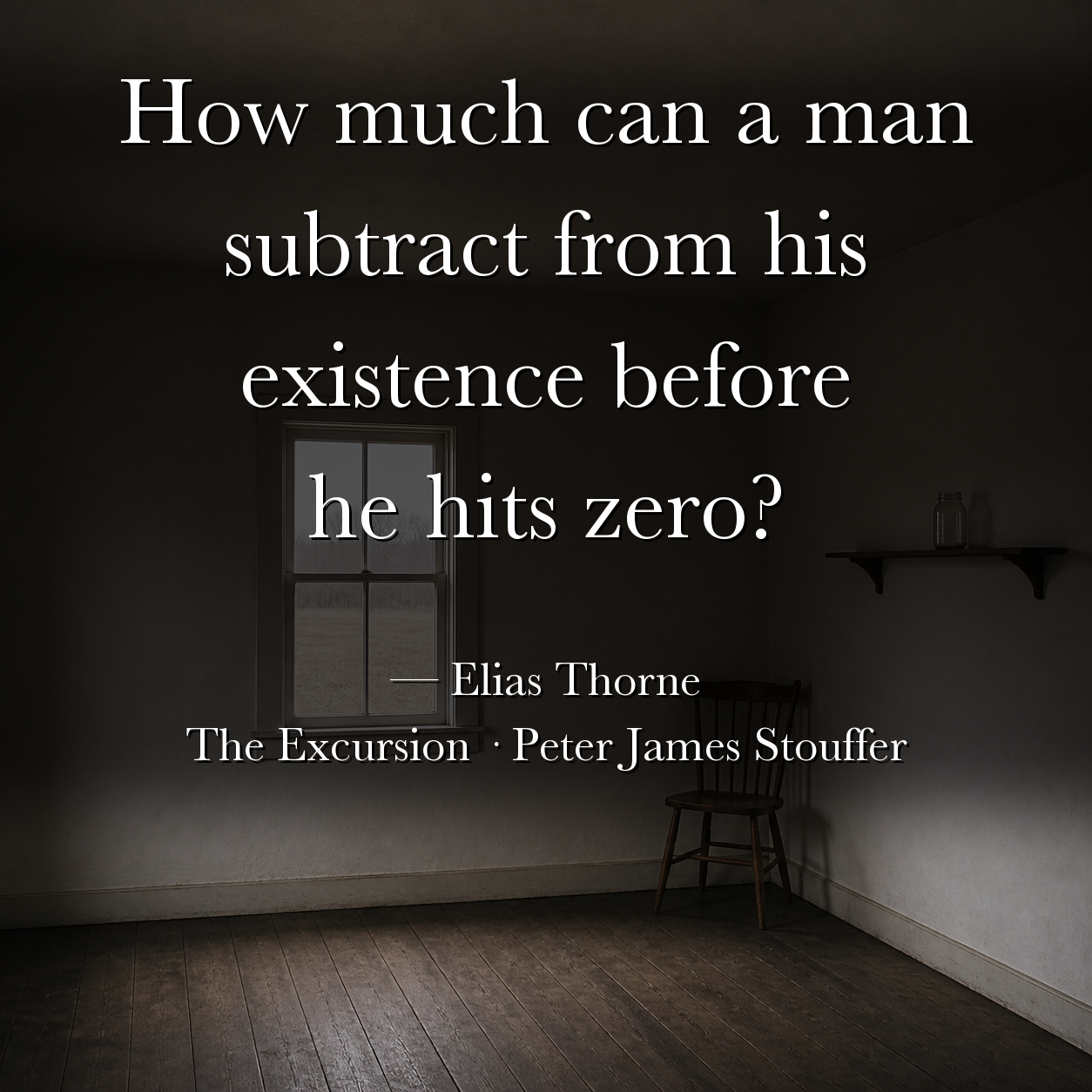
“You look at this place and you see a tragedy. You see a man who has ‘let himself go.’ That is the phrase, isn't it? ‘He really let himself go.’ But you are wrong. This isn't a tragedy. It is an experiment. I am a scientist. I am testing a hypothesis: How much can a man subtract from his existence before he hits zero?”Elias Thorne · Peter James Stouffer
Elias Thorne on subtraction, experiment, and the terrifying method a man builds around despair.
Elias Thorne · The Excursion II.ii
There Is No Bottom

“The bottom? There is no bottom. That's the joke. But come in. The mosquitoes are starting their shift. They are the only reliable workforce left in Michigan.”Elias Thorne · Peter James Stouffer
Elias Thorne on bottomlessness, contempt, and the joke that still opens the door.
Elias Thorne · The Excursion III.ii
There Is Only a Truce

“There is no Social Contract. There is only a truce. And the truce is ending.”Elias Thorne · Peter James Stouffer
Elias Thorne on the social contract, the truce beneath it, and the quiet moment when that truce begins to end.
Elias Thorne · The Excursion II.ii
No Memory of the Failure

“The geometry is perfect. Look at the tension. She builds the web every night. The wind destroys it every morning. She builds it again. She has no memory of the failure. That is her advantage over us, Samuel.”Elias Thorne · Peter James Stouffer
Elias Thorne on memory, failure, and the terrible weight of beginning again.
Narrator · The Excursion VII.iv
A Reflex He Had Subtracted
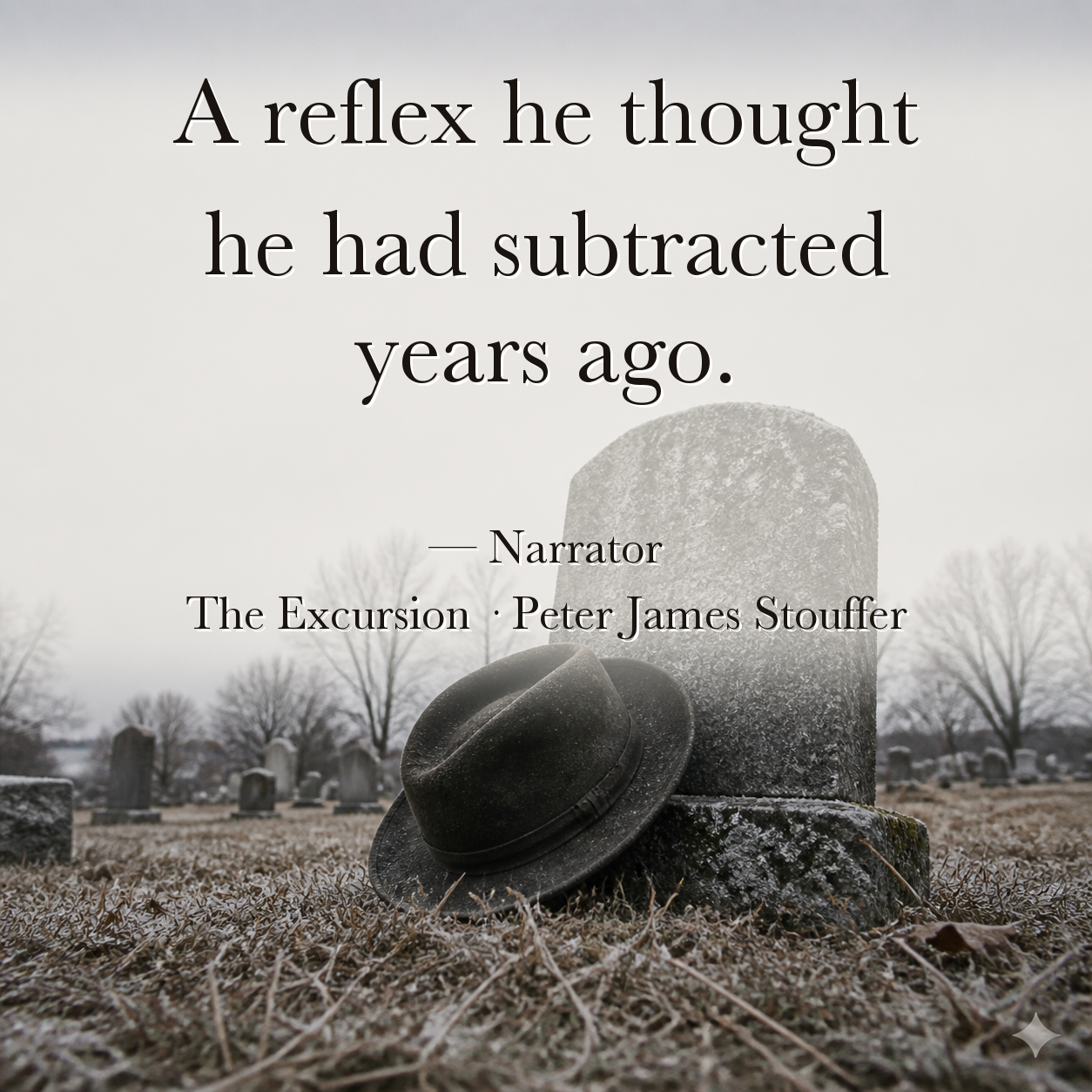
"He didn't sneer. He didn't quote Hobbes. He didn't argue that she was just biology returned to carbon. For the first time since we left the swamp, the Professor was silent. He took off his hat—a reflex he thought he had subtracted years ago—and held it against his chest."Narrator · Peter James Stouffer
The narrator on Elias Thorne, silence, reverence, and a reflex that survived subtraction.
Elias Thorne · The Excursion IX.iv
The Light Got In

"But I will admit... the walls of my logic were not as watertight as I thought. The damp got in. And today... the light got in."Elias Thorne · Peter James Stouffer
Elias Thorne on logic, damp, and the first light through a closed system.
Read together, the lines make Elias less a villain than a system under strain. His logic is formidable, but the novel keeps asking whether a man can subtract reverence, memory, hunger, and need without subtracting himself.