The Surface Film
The water strider moves without breaking the surface. It exploits the film between air and water — the surface tension of a Michigan lake in July — and skims across it with six bent legs, never touching what's underneath. To the strider, the lake isn't a body of water; it’s a trampoline. Touch the film and it sinks. Break the tension and it drowns.
Elias Thorne keeps a hand-bound manuscript on the table in his cabin. The cover is stained with tannin and age, the corners softened by a century of damp. The title is written in a script that speaks of 1920s precision: The Witness.
Everything else in the room is succumbing to the fen. The philosophy texts are furred with white mold. The wallpaper is peeling in long, jaundiced strips. The floorboards sink by degrees into the black muck beneath the joists. But this object is out of place. It is a dry thing in a wet world. When Jim Miller eyes it, Elias doesn't speak. He simply places his hand on the cover.
It is a protective gesture — odd for a man who claims to have subtracted the world.
Elias has spent decades stripping his life down to the studs. Career, faith, ambition, house, lawn, neighbors, the digital noise of the century — he peeled them away one by one until he arrived at what he believed was zero. He wanted the peace of the void. But he kept the manuscript. He couldn't say why. He just put his hand on it, as if the paper were a heat source.
Testimony outlasts the witness. Someone saw something in the 1920s, wrote it down, and the writing survived the rot — the tannin-dark water, the decades of Michigan winters — to end up on the table of the most dedicated nihilist in Rose Township. The relay was already running before Jim arrived.
Clean Boots and Porous Hearts
Jim arrives with clean boots and a notebook. Samuel Walker reads him in the first thirty seconds the way a farmer reads the sky: pale, anxious, checking his phone for a signal that isn't there. Jim doesn't notice being read. He’s too busy observing.
In Elias’s cabin, Jim tries to claim his territory: "I’m a freelancer. I observe."
Elias corrects him immediately: "You drift."
The distinction is not a semantic quibble. Observing keeps the subject at a distance. It requires the "clean boots" of the analyst — the ability to enter the material, record the data, and leave without tracking any of it home. Witnessing is something else. Witnessing requires contact. It requires that what you watch be allowed to land on you, to stain you, to change your weight.
There is another mode — its name was Ethan.
Ethan was a photographer, a Noticer of the first order. He would lie in the wet grass for hours, his pulse slowing, waiting for the light to hit a dragonfly’s wing just right. He was porous. The world entered him without a filter. He saw the beauty that we walk past, but he felt the ugly, too — the jagged edges of a world that didn't care if he noticed it. When the girl he loved left for Chicago, the silence she left behind was too loud to bear. He found that fentanyl could stop the aperture down, could finally bring the exposure to black. They found him in his darkroom, surrounded by prints of dead factories and winter fields, having finally achieved the perfect stillness.
Too much contact, no footing: that destroys. Too little contact, all surface: that drifts. Jim is in the second failure. He floats. He records. He nearly joins the subtraction — he can imagine the cot in the corner of Elias’s cabin, the phone battery dying, the world going quiet. He reaches for the glass of water. He sets it down.
Something is already shifting, quietly, without his permission. At the cemetery gate — after the Union Man and the Patriot, after Ethan’s headstone, after Baby Grace — Jim closes his notebook. He doesn’t note that he’s done it. He just stops recording.
The Active Principle
At the river, Samuel plants his staff in the mud. He speaks to Elias about the watershed — the current that carries water from the fen through the creek to the Great Lakes and back again as rain. The dammed pool. The active principle. The only sin, Samuel says, is to stop the flow.
Jim stands back, listening. He feels the pull of the water, but he feels the resistance of the bank, too.
The "Drift" I felt wasn't freedom. It was just stagnation. I had been floating on the surface like that water strider, terrified to put my feet down because I was afraid of the mud. But the mud was where the life was. The mud was where Mrs. Higgins stood when she lost her son. It was where Frank and Joe stood when they built the ridge.
He puts his feet down. Not dramatically. He just stops wanting to be a ghost.
Samuel turns to him. "Tomorrow, Jim, you have a story to write. Not about how the world is ending. But about how it persists."
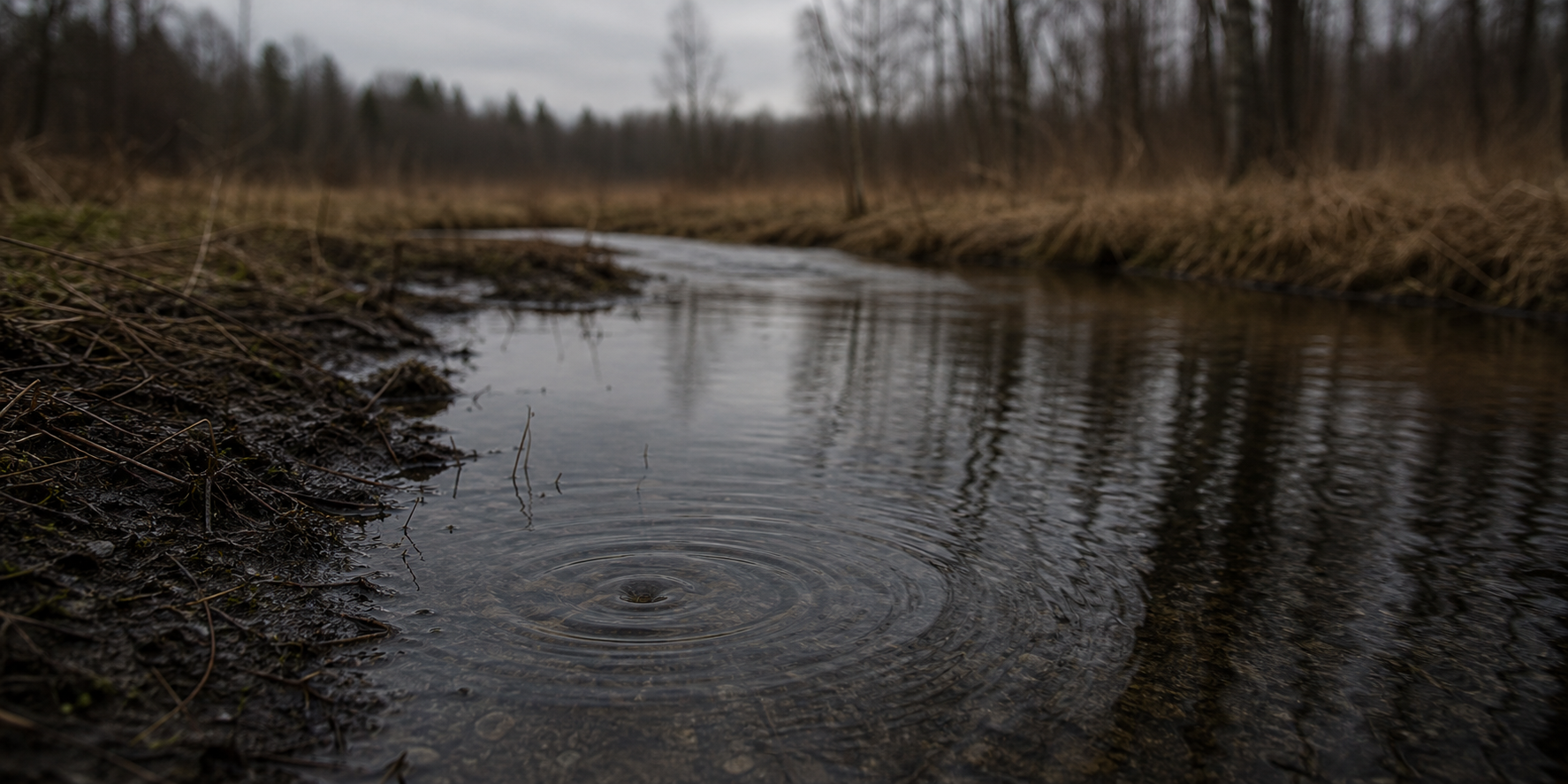
Elias bends to the riverbank. He picks up a stone — smooth, heavy, worn by ten thousand years of friction. He weighs it in his palm, feeling the cold grain of it. Then he tosses it in.
Plonk.
No dramatic splash. Just a small, wet sound consumed by the river. The stone settled on the bottom, joining the millions of other stones that made the bed. It wasn't drifting anymore. It was part of the architecture.