In 1816, the Surveyor General of the United States filed his report on the Michigan Territory. Edward Tiffin had walked the interior and concluded that not one acre in a hundred, not one in a thousand, would admit of cultivation. "Interminable swamp," he wrote. School geographies printed those words across the middle of the map. Settlement stalled. Men who might have come, didn't.
He was wrong. Not about the swamps, the swamps are real, and they are still here, but about what they meant. He walked the surface and mistook the surface for the truth.
It took eight years to correct him. In 1823, a deputy surveyor named Joseph Wampler led five men into what would become Rose Township, Oakland County, Michigan. They were not there to farm it or claim it. They were there to read it. Wampler noted what he found: rolling, hilly terrain. White and black oak. Hickory. Maple. Tamarack. Swampy wetlands along the low ground. Grassy prairies on the rises. He wrote it down. The land was given its first accurate accounting.
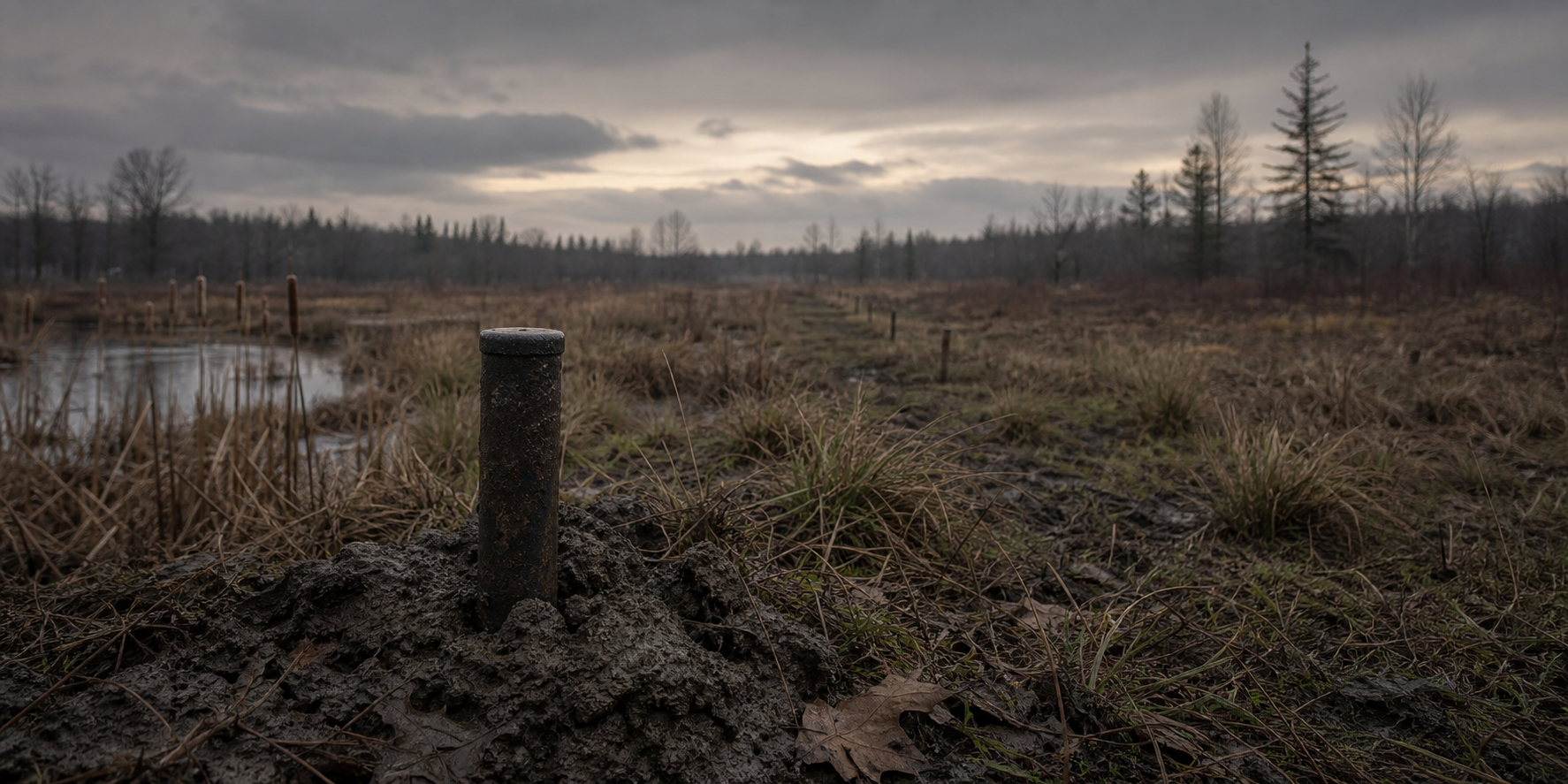
Then in 1834 a surveyor named Orange Risdon returned and did something different. He did not read the land, he divided it. He ran the section lines, drove the wooden stakes into the clay at every corner, and imposed the federal grid on the terrain Wampler had described. Thirty-six sections per township. One square mile each. A wooden post at every intersection. The ground was now claimable.
* * *
A year later the rush began. By 1836, the Detroit Land Office had closed its doors, too many people pressing in, and was taking payments through a window. $1.25 an acre. Minimum eighty acres. Cash only. A patent would follow by mail: a piece of paper signed by a clerk for the President, giving title to ground the buyer might never see.
Many didn't. Daniel Webster, Senator from Massachusetts, Secretary of State, one of the great orators of American life, bought sections 33 and 34 of Rose Township through a New York agent. He never came. He never smelled the calcium and peat of the fen air or put his boot through the sedge meadow. He paid at that window through a proxy, received a patent in the mail, and owned two square miles of Michigan clay until his speculation debts swallowed him whole.
The first land entry in Rose Township came June 8, 1835. Two men claimed a mill site on section 11. They planned to dam the river, grind grain for a city that hadn't been built yet. The mill never turned a wheel. The claim dissolved. The river kept moving north.
Then Daniel Danielson built the first house on section 35. He did not buy it through an agent. He came, he looked at the rolling hills and the tamarack and the fen, and he built something. His was the first structure in the township designed to last a winter.
The land received all of it, the patent mailed to Massachusetts, the failed mill, the first house. It kept the record without comment. But only one of those acts required someone to show up.
* * *
Two centuries later, a retired land surveyor named Samuel Walker went out to a farm where the fences had moved, the river had changed course, and the owner swore he owned up to the oak tree.
Samuel didn't look for the fence. He dug.
"I dug through the poison ivy and the clay until I hit the Section Corner. An iron pipe, driven five feet down in the twenties to replace the rotting white oak post set by the state engineers in the 1830s. It was rusted, yes. But it hadn't moved an inch. The grid holds true, Elias. Even when the surface turns to slush."