He left on a Monday. He kissed Maggie. He kissed the baby. He said, "I'll send the check in two weeks." He drove west toward the oil fields and disappeared.
That is where it begins — not with the poverty that came after, not with the baby who died in the winter, not with the county taking the children one by one. It begins on an ordinary Monday morning in Rose Township, Michigan, with a kiss. Maggie Kowalski had strong hands and eyes that were always looking for a reason to laugh, even when there wasn't one. She stood on the porch of a house built from cheap promises and watched the truck go. She never found out what happened to him.
That is the detail that matters. Not the disasters that followed — those are catastrophes, and catastrophes can be grieved. What you cannot grieve is a question that never gets answered. Maggie had no ending. She had a Monday morning kiss and a two-week promise and then silence that became a season and then a life. She waited while the weeds took the lawn. She waited while the bank notices piled up like snowdrifts against the door. She waited until waiting was the only thing she was.
She died on the porch steps. Found by the mailman on a Tuesday.
"She died of waiting," says the man who knew her. "Come August the bank will doze it flat. The woods will take it back. In five years you'd never know a woman stood on this porch and loved a man who didn't come home."
* * *
In a sinking cabin off Fish Lake Road, a former professor named Elias Thorne had made a different calculation. He had loved his wife fully — not as a hedge against loneliness but as the ground he stood on. He had two children. Then a drunk driver on I-75 subtracted all three in a single second. The pavement did not care. The drunk driver was out in eighteen months on a procedural error. The insurance actuary explained the replacement value of a seven-year-old girl. The university suggested a sabbatical, because his grief was making the department uncomfortable at mixer events.
Elias knew exactly what had happened. He had full information, full loss, and a perfectly intact mind with which to understand that every institution he had believed in — legal, financial, academic — had looked at his devastation and turned away. So he subtracted himself instead. The career. The faith. The ambition. The house, the lawn, the neighbors. He moved to the swamp and called it honesty. He had stripped everything away to see what remained. His answer was nothing. A biological machine, waiting to rust.
What Elias had that Maggie didn't was people who refused to let him finish. A land surveyor who kept driving out to Fish Lake Road and knocking on the cabin door. A priest who brought him out of the swamp and walked him through a cemetery. A woman behind a coffee counter who told him his grief was going moldy in the dark and it was time to share the load. They did not have a better argument. They just would not leave him alone with it.
* * *
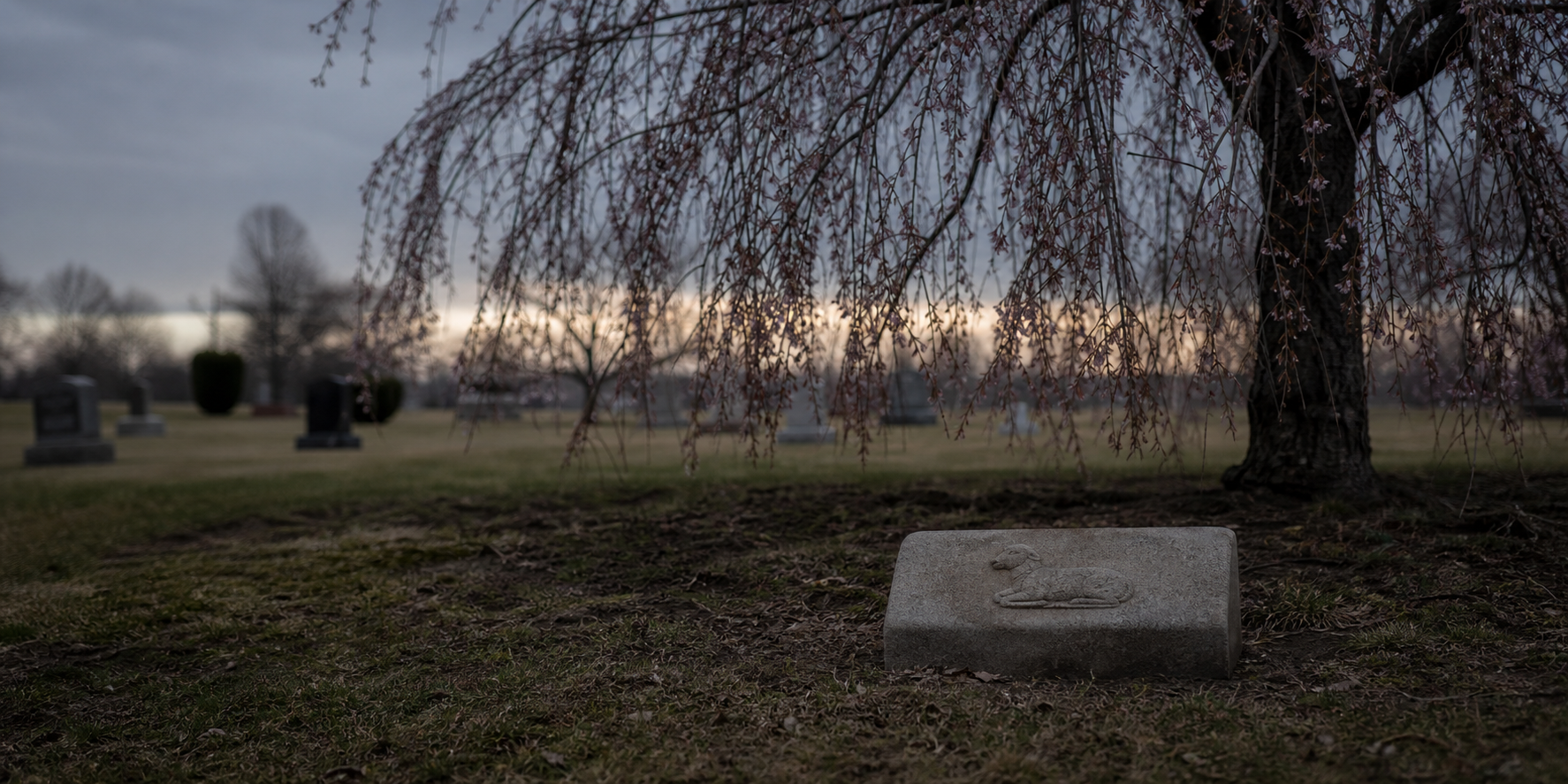
There is a small stone in the cemetery at St. Jude's — no bigger than a shoebox, set under a weeping cherry tree. One name: Grace. A date that spans only four months. The lamb carved into the top is worn smooth by the touch of passing fingers.
Father Tom stops here. The air around the stone is different — heavier, still.
The parents of that child did not close around their grief. They stood in the freezing rain with a priest who had no answers. They put her in God's hands and kept walking — kept coming back to this stone until the lamb was worn smooth and the date was no longer just a date but a place the whole congregation carried. Grace became the still center that everything else moved around.
"The human animal," Father Tom says, "cannot bear to be alone."
Elias turns. He looks at the stone. He looks at the lamb. He does not sneer, does not quote Hobbes, does not argue that she was just biology returned to carbon. He takes off his hat — a reflex he thought he had subtracted years ago — and holds it against his chest.
"The silence," he says, his voice cracking, "is very loud here."
Father Tom puts his hand on Elias's shoulder. The professor doesn't flinch.
"I have no theology for this," the priest says. "I have no verse that explains a cradle robbed. When I stood here with the parents in the freezing rain, I didn't talk of God's Plan. That is an insult to a mother's grief. I didn't talk of Better Places."
Elias doesn't turn away. "Then what did you do?" he asks.
"I just stood there."